Why n8n Is Not Enough for Enterprise AI in Singapore
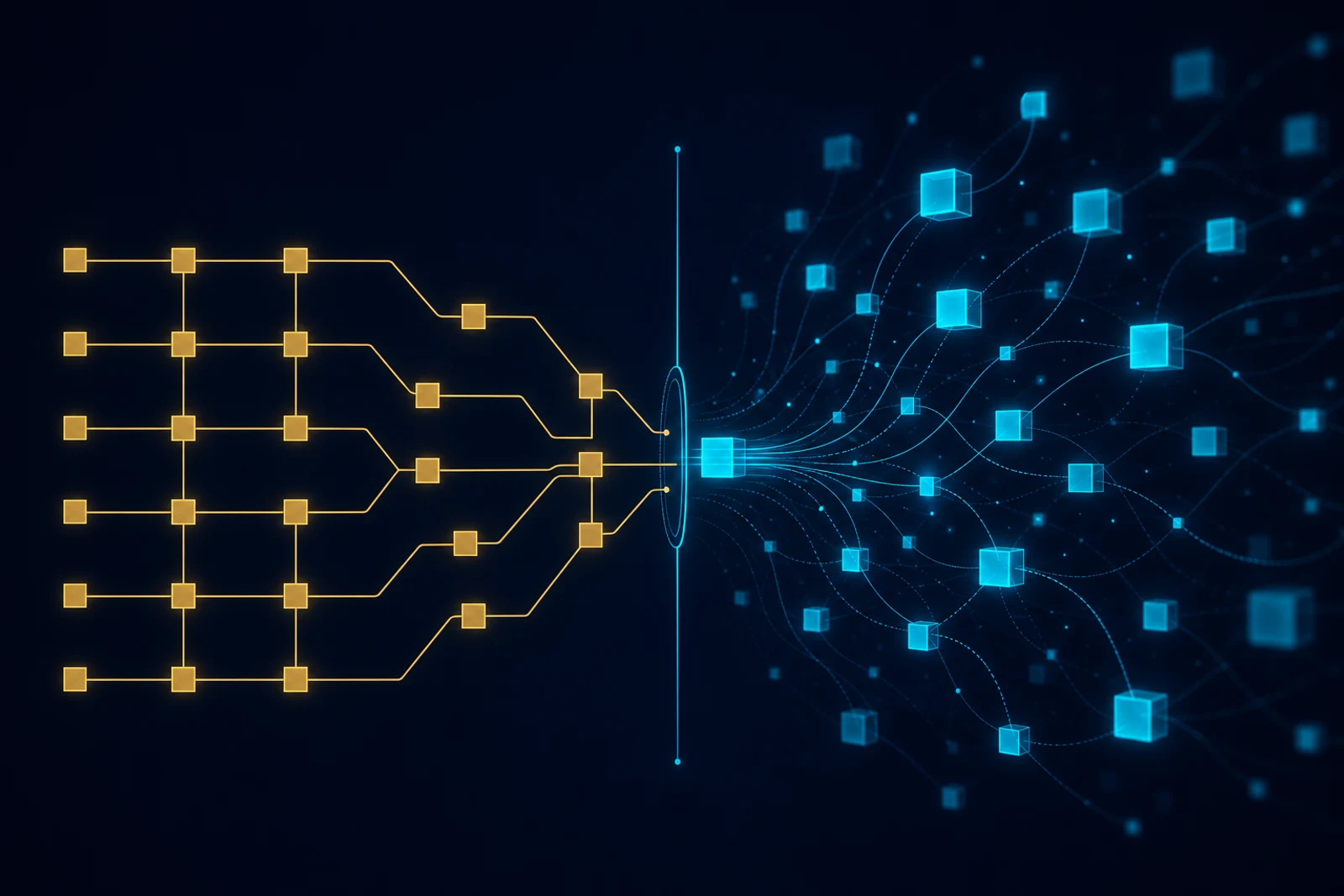
n8n is a deterministic workflow automation engine that moves data between APIs based on predefined triggers and branching logic. It is not an AI agent platform — it cannot reason about unstructured inputs, retain contextual memory across interactions, make multi-step decisions under uncertainty, or enforce human approval checkpoints before high-impact actions. For Singapore enterprises whose automation requirements have progressed beyond data routing into intelligent decision-making under PDPA and CSA governance constraints, a purpose-built agent operating system — the OpenClaw execution gateway, the Hermes Agent OS orchestration layer, and the Mission Control command interface — provides the architectural capabilities that workflow tools were not designed to deliver.
For the wider context, see AI agents in Singapore: deployment models compared. This distinction matters because n8n is genuinely good at what it does. Operations teams across Singapore use it to synchronise records between systems, trigger notifications on status changes, and automate repetitive data movement that would otherwise consume analyst hours. Dismissing those capabilities would be inaccurate, and technical buyers who have run n8n in production would rightly dismiss an article that tried. The argument here is narrower and more precise: n8n occupies a specific architectural category — deterministic workflow automation — and enterprise AI workloads belong to a different category entirely.
The inflection point arrives when a workflow stops being a routing problem and becomes a judgement problem. When the requirement shifts from "move this payload from system A to system B" to "read this unstructured input, decide what it means, recall relevant history, choose the appropriate action, and obtain human authorisation before executing it," the node-graph model has no native machinery to offer. In Singapore, that inflection point carries an additional dimension: the Personal Data Protection Act 2012 and the Cyber Security Agency of Singapore's guidance on securing AI systems impose obligations that workflow tools were never architected to enforce at the runtime level. The sections that follow examine exactly where n8n's ceiling sits, what lies beyond it, and what a governed agent operating system must provide for regulated Singapore operations.
What n8n Does Well — and Where the Ceiling Is
Strengths: Deterministic Workflow Execution
n8n excels at API-to-API data movement, scheduled triggers, conditional branching, data transformation pipelines, and webhook orchestration. These are production-grade capabilities, and the breadth of its connector library reflects years of community contribution. Routing form submissions into HubSpot, triggering Slack notifications when a deal stage changes, syncing invoices between Xero and a CRM — these are workloads n8n handles reliably and at low operational cost. For operations directors automating well-understood, repetitive processes, n8n delivers measurable recovered hours without requiring custom development.
Its self-hosting option also matters. Unlike purely SaaS automation platforms, n8n can run on infrastructure the enterprise controls, which addresses a baseline data-residency concern. That capability is necessary for serious Singapore deployments, but, as the regulatory section below explains, it is not sufficient.
The Architectural Ceiling
n8n's execution model is fundamentally node-graph-based: each node performs a discrete, predefined operation on structured input. There is no reasoning step between trigger and action, and no mechanism for the system to evaluate ambiguity, weigh trade-offs, or decide that a different action is warranted based on context not present in the trigger payload.
There is no persistent memory. Each workflow execution is stateless; if a customer submits a second support ticket, the workflow does not know about the first one unless that context is explicitly fetched from an external store and injected as input. There is no native human-approval gate. n8n's "Wait" node is a pause mechanism, not a governance primitive: it does not log who approved, when, on what basis, or record the decision for audit.
The gap is not a feature deficiency that n8n's roadmap will close. It is an architectural category boundary: workflow automation tools execute predetermined paths; agent operating systems evaluate, decide, and act within governed boundaries.
The Four Capabilities Workflow Tools Cannot Provide
1. Contextual Reasoning Over Unstructured Input
n8n processes structured payloads: JSON fields, form data, webhook bodies. Its "AI" nodes are wrappers around external LLM API calls, so the reasoning happens outside n8n's execution boundary, and n8n merely routes the request and response. The enterprise's data leaves the controlled environment, the model's output returns as another payload, and no governance is applied to what the model was shown or what it produced.
An agent operating system such as Hermes performs reasoning inside the execution boundary. The agent reads an incoming support ticket, classifies its urgency based on customer tier and historical interaction patterns, determines the correct routing target, drafts a response, and stages it for human review, all within a single governed execution cycle.
The support triage pipeline demonstrated on the VYR platform illustrates this architecture in operation: an unstructured support ticket enters the system, is classified and prioritised through named processing stages, reaches a mandatory human approval gate where an operator reviews the agent's draft response before any external action is taken, and upon explicit approval is written back to the ticketing system with a complete audit log entry. No high-impact action executes without that human checkpoint; the pipeline is not autonomous or unattended.
2. Persistent Memory Across Interactions
Statelessness is a design property of workflow tools, not a defect, but it becomes a constraint the moment decisions depend on history. An agent OS maintains memory galaxies: structured representations of entity relationships, interaction history, and contextual state that persist across agent invocations and inform future decisions without explicit re-fetching.
The practical consequence is concrete. When an invoice arrives from a vendor with a history of pricing discrepancies, the agent recalls the prior dispute history, cross-references the current invoice against the agreed pricing schedule, flags the discrepancy, and routes it for review, without a human needing to manually attach the historical context.
The invoice processing pipeline, also visible on the VYR platform, demonstrates memory-informed execution: an invoice document is ingested, extraction and validation stages check line items against expected values, exceptions are routed to a mandatory human approval gate, and a governed writeback to the accounting system occurs only after explicit human authorisation, with an audit trail recording the decision.
3. Multi-Agent Coordination
n8n executes linear or branching node graphs. There is no concept of multiple specialised agents collaborating on a single complex task. Parallel branches exist, but parallel execution is not collaborative specialisation.
An agent OS orchestrates multiple agents with distinct roles: one agent extracts and structures data, another validates it against business rules, a third drafts the response or action, and a fourth enforces the governance checkpoint. Each agent operates within a defined scope (different reasoning profiles, different data access permissions, different authority levels) and the orchestration layer coordinates their handoffs within a single governed workflow. A support ticket requiring both technical diagnosis and customer communication can be handled by two agents with different scopes, neither exceeding its authority, with the orchestration layer sequencing their contributions.
4. Governance as an Enforced Runtime Constraint
This is the capability that separates a governed agent deployment from every "n8n plus an LLM API" assembly. n8n's governance model is external: access control on the instance, credential management via environment variables, audit logging at the platform level. These are operational controls applied around the tool.
An agent OS enforces governance inside the execution boundary:
- Human-approval-gate checkpoints. Mandatory review stages that physically prevent the agent from executing a high-impact action (writing to a production system, sending a customer communication, modifying a financial record) until a human operator explicitly approves. The approval, the approver identity, the timestamp, and the decision basis are logged to an audit trail.
- Sandboxed Node runtimes. Agent code executes within restricted filesystem primitives that prevent access to directories and environment variables outside the agent's authorised scope.
- Proxy-controlled network gateways. Outbound calls from the agent pass through controlled egress points that prevent unauthorised data transmission to external endpoints, the technical mechanism that keeps personal data inside governed boundaries.
- Fleet telemetry. A unified command interface, the Mission Control dashboard, exposes real-time status of every agent in the fleet, including execution state, memory galaxy contents, model telemetry, and intervention history, giving compliance officers a single surface for oversight.
The Singapore Regulatory Dimension — Why This Is Not a Generic Argument
The architectural argument above applies globally. What makes it a Singapore enterprise argument is the specific regulatory environment in which the deployment must operate.
PDPA Protection Obligation (Section 24, Personal Data Protection Act 2012). This provision obliges organisations to protect personal data in their possession or control by making reasonable security arrangements. When an AI agent processes customer data containing personal identifiers (names, NRIC numbers, contact details, financial information) the Protection Obligation applies to the agent's execution environment. Workflow architectures that pass personal data to external LLM APIs without data egress controls create exposure under this obligation. A sovereign agent runtime with proxy-controlled network gateways and zero uncontrolled external data egress provides the technical enforcement mechanism: not a policy statement, but a runtime constraint.
CSA Guidelines on Securing AI Systems (Cyber Security Agency of Singapore, 2024). These Guidelines provide a lifecycle framework for securing AI systems across development, deployment, and operation, addressing threats including adversarial attacks, model poisoning, and data leakage. The Securing Agentic AI Addendum extends that framework specifically to agentic AI systems, addressing the risks of agents that can take actions on systems, including unauthorised system access, prompt injection leading to harmful actions, and insufficient human oversight. An agent architecture with enforced human approval gates and sandboxed execution maps directly onto the Addendum's concerns; a workflow tool with bolted-on LLM calls does not.
MAS Technology Risk Management Guidelines (Monetary Authority of Singapore). For financial sector enterprises, the MAS TRM Guidelines impose requirements on system access controls, audit trail integrity, and technology risk governance. AI agent systems executing financial workflows (invoice approval, payment authorisation, customer communications) must operate within TRM-consistent boundaries, which makes per-decision audit trails and enforced approval checkpoints a compliance property rather than a convenience.
The regulatory landscape does not prohibit AI agent deployment. It requires that the deployment architecture demonstrate enforceable governance rather than policy aspiration. The distinction between "a governance policy exists" and "the system physically prevents unauthorised actions and logs every decision for audit" is the core of the matter.
Runtime hardening against catalogued vulnerabilities. AI agent runtimes introduce vulnerability classes that workflow tools do not. Hardened runtimes isolate credentials so that token material never enters the model’s context window, which limits the blast radius of any credential-handling defect in the underlying framework. CVE-2026-24763 was a command-injection flaw in OpenClaw’s Docker sandbox (unsafe PATH handling when building shell commands), fixed in 2026.1.29, in which an authenticated user controlling environment variables could influence command execution within the host environment; sandboxed execution with restricted filesystem primitives and command whitelisting at the runtime layer mitigates it. These are catalogued, measurable exposures: factual risk that enterprise buyers deploying agentic AI must address at the architecture level.
Comparison — n8n vs the OpenClaw + Hermes Agent Operating System
| Capability | n8n (Workflow Automation) | Agent OS (OpenClaw + Hermes + Mission Control) |
|---|---|---|
| Execution model | Deterministic node graph — predefined triggers, branching, transforms | Agent reasoning loop — evaluate, decide, act, learn within governed boundaries |
| Input handling | Structured payloads (JSON, form data, webhooks) | Unstructured and structured — natural language, documents, images, audio |
| Memory | Stateless — each run starts fresh; context externally injected | Persistent memory galaxies — entity relationships, interaction history, contextual state |
| Decision-making | Conditional logic (if/else, switch) on known fields | Contextual reasoning under uncertainty — weighs trade-offs, escalates when confidence is low |
| Multi-agent coordination | Not supported — single workflow, linear or branching execution | Native — multiple specialised agents with distinct roles, scopes, and authority levels |
| Human approval gate | "Wait" node (pause mechanism — no governance logging) | Enforced checkpoint — blocks execution, logs approver identity, timestamp, decision basis to audit trail |
| Runtime hardening | Instance-level access control | Sandboxed Node runtimes, restricted filesystem primitives, proxy-controlled egress, CVE-mitigated |
| Audit trail | Platform-level execution logs | Per-decision audit — every agent action, approval, and intervention recorded with full context |
| Named Singapore integrations | Generic connectors (community-maintained, varying quality) | Purpose-built integration with Xero, HubSpot, Slack, Talenox, Payboy |
| Fleet visibility | Per-workflow execution view | Mission Control dashboard — fleet status, memory galaxies, model telemetry, intervention history |
| Regulatory alignment | None — tool vendor does not reference Singapore frameworks | CSA Guidelines on Securing AI Systems + Securing Agentic AI Addendum, PDPA Protection Obligation (Section 24), MAS TRM |
This table is not a feature checklist; it is an architectural category comparison. n8n is a strong tool within its category, and nothing in the left-hand column should be read as a defect for the workloads that category was built to serve. The argument is that the category itself is insufficient when the requirement is governed AI agent deployment rather than workflow automation. An operations director evaluating this table should not conclude that n8n is a poor tool; the correct conclusion is that n8n is the wrong tool for this category of problem, in the same way that a reliable delivery van is the wrong vehicle for freight that requires a refrigerated container. The workloads in the right-hand column (reasoning over unstructured input, memory-informed decisions, enforced governance, per-decision audit) demand an agent operating system: the OpenClaw execution gateway running agents on infrastructure the enterprise controls, the Hermes Agent OS coordinating multi-agent workflows and memory, and Mission Control exposing fleet-wide telemetry and intervention history.
When n8n Is the Right Choice — and When It Is Not
n8n Remains the Right Tool When:
- The workflow is fully deterministic: every input has a known, predictable mapping to an output.
- No reasoning step is needed between trigger and action.
- All data is structured and arrives in a consistent format.
- Human oversight is provided externally (a person checks the output) rather than required as an enforced system gate.
- The workflow does not process personal data subject to PDPA in a way that creates egress exposure.
An Agent OS Becomes Necessary When:
- The workflow must handle unstructured input (natural language emails, documents, support tickets) and make contextual decisions about routing, prioritisation, or response.
- The system must retain memory of prior interactions and use that memory to inform current decisions.
- Human approval is required before high-impact actions, not as a best practice, but as a governance enforcement point with audit logging.
- The workflow processes personal data subject to the PDPA Protection Obligation, and the data must not leave controlled execution boundaries.
- Multiple specialised agents must collaborate on a single complex task.
- The organisation needs fleet-level visibility into agent behaviour, memory state, and intervention history for compliance reporting.
Named Integration Reality — The Singapore Software Stack
Enterprise automation in Singapore is not abstract. It means integrating with the specific software Singapore enterprises actually use to run operations: Xero for accounting, HubSpot for CRM, Slack for internal communications, Talenox for payroll and HR, and Payboy for workforce management and scheduling.
n8n's community connectors for these platforms vary in quality, maintenance status, and feature coverage, particularly for Talenox and Payboy, which have limited or no maintained n8n connectors. HTTP request nodes can bridge gaps, but that approach shifts API versioning, authentication renewal, and schema-change maintenance onto the internal team. Purpose-built, maintained, and tested integration with the full Singapore enterprise stack is a different operational reality from wiring up community connectors and hoping they survive the next API revision. For a CTO accountable for uptime across payroll and accounting flows, that difference is not cosmetic.
The Competitive Landscape — What Other Singapore Providers Offer
A natural buyer question follows: why not engage an automation agency that builds on n8n? Some Singapore providers do exactly that, layering implementation, maintenance, and support services on top of a self-hosted n8n instance. The service layer is real value, but the architectural limitation remains untouched: the underlying engine is a deterministic workflow tool, and adding services around it does not give it reasoning, memory, multi-agent coordination, or enforced governance gates.
Other providers offer self-hosted custom builds framed as PDPA-aligned. Self-hosting is a baseline requirement, not a differentiator, and multiple providers can answer yes to it. The discriminating questions are harder: does the system enforce human approval gates at the runtime level? Does it produce per-decision audit trails? Does it align with the CSA Guidelines on Securing AI Systems and the Securing Agentic AI Addendum? Is the runtime hardened against catalogued agent-specific CVEs? These capabilities distinguish a governed agent deployment from a custom automation build, and from big-consultancy AI programmes that deliver governance frameworks as documents rather than as enforced runtime constraints.
VYR's OpenClaw + Hermes stack is positioned against exactly these criteria: governed agent deployment with enforced runtime constraints, per-decision audit trails, CSA Addendum alignment, and CVE-hardened execution, delivered as architecture, not as policy documentation. The broader hardening sequence, mapped to CSA controls, is set out in AI agent security hardening in Singapore.
Migration Considerations — If n8n Is Already Deployed
Many enterprises reading this already run n8n in production. The rational framing is not replacement but boundary-setting.
n8n workflows performing purely deterministic data routing do not need to be migrated; they can continue running alongside an agent OS. The migration question applies only to workflows that have hit the architectural ceiling, where teams are forcing n8n to approximate reasoning, memory, or governance through increasingly complex webhook chains, external LLM API calls, and manual human-in-the-loop workarounds held together with spreadsheets and chat messages.
Migration in this context is not a tool switch from n8n to another workflow tool. It is an architectural upgrade: deterministic routing stays where it works, while the intelligence, decision-making, and governance layers move to the agent OS. A detailed, phased treatment of moving existing n8n, Zapier, and Make workflows onto a governed agent OS, including workload triage criteria and cutover patterns, is set out in the migration guide for Singapore enterprises.
Frequently Asked Questions
Can n8n be used as an AI agent platform?
n8n can call external AI APIs through its AI nodes, but the reasoning happens outside n8n's execution boundary, and n8n merely routes the request and response. A true AI agent platform performs reasoning, memory retrieval, and decision-making inside a governed runtime environment with human approval gates and audit logging. n8n is a workflow automation engine, not an agent operating system.
What is the difference between workflow automation and AI agent orchestration?
Workflow automation executes predefined, deterministic paths: a trigger fires, data moves through conditional branches, and an action is taken. AI agent orchestration involves reasoning about unstructured input, consulting persistent memory, making contextual decisions under uncertainty, and enforcing human approval before high-impact actions. These capabilities require a fundamentally different architecture.
Does n8n comply with Singapore's PDPA requirements?
n8n as a tool can be deployed in a PDPA-aware configuration, but PDPA compliance depends on how the system processes and protects personal data, including whether data is transmitted to external LLM APIs without egress controls. A purpose-built agent runtime with proxy-controlled network gateways and sandboxed execution provides enforceable data protection at the execution layer that workflow tools cannot guarantee.
What is the CSA Securing Agentic AI Addendum?
The Securing Agentic AI Addendum is an extension of the Cyber Security Agency of Singapore's Guidelines on Securing AI Systems, addressing the specific risks of AI agents that can take actions on systems, including unauthorised system access, prompt injection, and insufficient human oversight. Singapore enterprises deploying agentic AI should evaluate their systems against both documents.
How does a human approval gate work in an AI agent system?
A human approval gate is an enforced checkpoint in the agent's execution cycle where the system physically pauses before a high-impact action (such as writing to a production database, sending a customer communication, or modifying a financial record) and waits for a human operator to review the proposed action and explicitly approve or reject it. The approver's identity, the timestamp, and the decision are recorded in an audit trail.
When should a Singapore enterprise upgrade from n8n to an AI agent platform?
The upgrade is warranted when automation requirements extend beyond deterministic data routing into tasks requiring contextual reasoning, persistent memory, or enforced governance, such as intelligent support triage, invoice validation with dispute history, or lead routing based on multi-factor scoring. If the team is building increasingly complex workarounds to force n8n to approximate these capabilities, the architectural ceiling has been reached.
Summary — The Architectural Boundary, Not a Feature Gap
n8n is a competent workflow automation tool with genuine strengths in deterministic, rule-based data movement, and those strengths are not diminished by the argument presented here. The limitation is architectural, not functional: it is not a missing feature that a roadmap update will deliver. Enterprise AI requires contextual reasoning, persistent memory, multi-agent coordination, and governance enforced at the runtime level, capabilities that belong to a different category of system. For Singapore enterprises operating under the PDPA Protection Obligation, the CSA Guidelines on Securing AI Systems and its Securing Agentic AI Addendum, and (where applicable) the MAS TRM Guidelines, the choice is between workflow automation with external governance controls and an agent operating system with governance enforced inside the execution boundary. The decision is not "n8n versus another workflow tool"; it is the workflow automation category versus the agent operating system category, evaluated against the specific workloads and regulatory context the enterprise faces.
Enterprises assessing that boundary can request a technical scoping call with VYR to map current workflows against the architectural criteria outlined above and determine whether an OpenClaw + Hermes agent OS deployment is warranted. For the comprehensive side-by-side treatment, see the forthcoming architectural comparison of OpenClaw and n8n for Singapore enterprises.
Singapore enterprise entities embarking on custom development projects may evaluate eligibility for co-funding via the Enterprise Development Grant (EDG) administered by Enterprise Singapore.